

Most people think about income in one of two ways: either they trade time for money in a job, or they invest money and hope it grows quietly in the background.
But there’s a third way that fits the Rich Minimalist mindset much better: build a freedom portfolio.
What’s a freedom portfolio?
It means choosing a small number of side projects that are aligned with your skills, your values, and your life, then giving them enough focus and structure that they can eventually produce meaningful income: some active, some passive, and ideally a bit of both but more towards passive. We wanna be free eventually.
I like this idea because it feels very human. It doesn’t require becoming a full-time entrepreneur overnight, and it doesn’t force you into the usual “hustle culture” trap where everything becomes about scale, speed, and endless noise and endless work hours. Instead, it asks a better question:
What are the few projects that could genuinely improve my life, give me joy, are aligned with my values, and create more freedom over time?
That is a much more sustainable way to think about money, and a portfolio of projects that create money.
The freedom portfolio concept also fits beautifully with the kind of life I live and want more of. The tiny house, camper van rentals, the Spartan Race Preparation Program, my writing, and the new Financial Freedom Mentor app all sit in the same general ecosystem. They are different, but they share the same DNA: they are low-overhead, intentional, practical, and closely tied to the life I actually want. That’s the point. A freedom portfolio is not random side-hustle chaos. It is a curated collection of projects that point in the same direction, that you identify with and that you are passionate about.
Why a freedom portfolio matters
If you depend on one single source of income, your freedom is fragile. Lose the job, lose the contract, get burned out, get sick, or simply stop enjoying the work, and suddenly everything becomes unstable.
A freedom portfolio spreads that risk out. Exactly like an investment portfolio.
It gives you more than one engine. One project can be slow to mature while another is already producing cash. One can be more active and hands-on, while another becomes more passive over time. Most projects fail by the way—as I know from my own (many) painful experiences. So it’s good to have several and abandon the ones that don’t work without killing the portfolio.
More importantly, it changes the emotional texture of earning money. Instead of feeling trapped in one role, you start to feel like you are building a set of assets—some financial, some creative, some experiential—that all reinforce your independence. That is a huge shift. You’re no longer only exchanging hours for salary. You’re building things that can continue to serve you later.
I also learned that after some projects, the portfolio develops its own inertia. Even though the projects may be very different, there are always similarities and transferable skills. For instance, finding customers who are willing to pay, creating a landing page, or setting up email campaigns.
This is also where minimalism becomes a real advantage. When your life is simple, your fixed costs are lower, your mental load is lighter, and your schedule has more breathing room. That means you actually have the energy to work on side projects without feeling like your life is already overflowing.
In other words:
Simplicity creates capacity. Capacity creates optionality. Optionality is freedom.

How to choose the right projects
Not every idea deserves a place in your freedom portfolio. If you try to build ten things at once, you’ll probably build nothing well. The key is selection. You want projects that are aligned, realistic, and worth the effort. I usually think about them through a few filters.
Filter 1: Skill
First, does the project use skills you already have or are willing to build? That matters because leverage comes from competence. If you know how to write, teach, film, design, organize, sell, build, host, or explain things clearly, those are powerful foundations. All my projects and offers came from this principle. I am not trying to become someone else. I am trying to extend what already made sense in my life.
Filter 2: Passion (or at least liking)
Second, do you actually enjoy the project? Because if you hate the process, you probably won’t stick with it long enough for it to compound. A good side project should have at least some intrinsic joy. It doesn’t have to be easy, but it should feel meaningful. I enjoy creating things that are useful, simple, and aligned with freedom. That is why the tiny house, camper vans, and the writing all make sense together.
Filter 3: Leverage
Third, does the project have leverage? In other words, can one effort serve many people, or keep paying you after the initial work is done? An ebook, an app, a rental property, a digital guide, or a well-structured coaching program can all do that. They all scale and are good candidates for passive income. A project with low leverage may still be valuable, but if your goal is future passive income, leverage matters a lot.
Filter 4: Overhead
Fourth, what is the overhead? If a project requires huge monthly costs, lots of management, or constant problem-solving, it may become a burden instead of a freedom asset. That’s why I love low-overhead ideas like digital products, like ebooks or downloads of guides, simple systems, and focused online tools. They can be managed leanly, and that preserves your margin.
Filter 5: Passive Income
Fifth, how much of the income is active versus passive? Some projects will always have an active component, and that’s fine. The goal is not perfect passivity. In fact, it’s not possible. All projects will need some steering at some points. The goal is to move the balance over time. For example, an app may require updates, support, and marketing, but it can still generate income long after the initial work has been done. That is a very different thing from a pure hourly model. It’s one of the reasons why I stopped one-on-one personal coaching. It’s lovely but it does not scale.
Filter 6: Alignment
And finally, does the project align with your principles? This part is crucial. I don’t want to build random stuff just because it could make money. I want projects that reflect the same values I write about: simplicity, independence, health and fitness, time richness, minimalism, nature, and honest value creation. If a project conflicts with those principles, it will eventually feel wrong, even if it earns money.

My own freedom portfolio
In my case, the most natural examples are all connected.
The Viking Tiny House is a great example of a freedom asset that also reflects my philosophy. It is not just a house; it is an experience, a place of retreat, and eventually a rental concept for people who want to disconnect and reconnect with nature. It fits the Rich Minimalist mindset because it offers high value with relatively low complexity. It is small, intentional, and meaningful.
The camper van rental idea sits in a similar category. Fred, my camper van is not just a vehicle. It is a mobile freedom platform. For the right person, it can be a source of adventure and a source of income at the same time. The key is usefulness and flexibility.
The Spartan Race Preparation Program is another good example. It comes from a real interest and a real personal experience. It’s not fake guru content. I completed nice Spartan races and initially found it challenging to prepare effectively. So, I developed this program to share my experience of what works related to training intensity, the right exercises, nutrition, recovery and crucial race day do’s and dont’s. When a project comes from real life, it tends to be more authentic, easier to explain, and more useful to others.
Then there are ebooks, writing, and educational content. These are classic freedom portfolio assets because they can be created once and sold many times. They also fit very well with a minimalist lifestyle because they require very little overhead. No warehouse. No inventory. No staff. Just ideas, structure, and distribution. Most my content is free. My ebooks are very cheap because they are mostly intended to increase visibility.
And then there is my new Financial Freedom Mentor app. This is probably the cleanest “eat your own dog food” example of the entire concept. It started as a passion project and a tool for myself. I built it because I wanted something practical to support the way I think about money and freedom.
At some point I thought: “Hm, if this is useful for me, it may be useful for others, too.“ So, I polished the app, published it, and now I’m trying to generate passive income from it by helping other people use it too.
That is exactly how a freedom portfolio should work: It began as something useful to me and support me in building my freedom portfolio, and now it has the potential to become useful to others while creating income in the background.
That’s the win-win. I get a tool I believe in. Other people get a tool that helps them. And if the project works, it can continue to produce value over time without needing to consume my whole life. If other people find value in it, they will be willing to pay. Then it’s a nice win-win situation and a successful project.

Protecting focused time
The biggest threat to a freedom portfolio is not lack of ideas. It’s lack of time. Side projects die when life gets too noisy. That is why simplification is not just a nice lifestyle choice. It is a strategic necessity.
If you want projects to compound, you need protected blocks of focus. That means fewer unnecessary obligations, fewer low-value commitments, and fewer distractions. It means keeping your life lean enough that you can still think clearly after work. It means being honest about what drains you and what feeds you.
For me, that often looks like a simple routine: work sessions that are focused, daily or weekly creative blocks, and a lifestyle that doesn’t create too much clutter, debt, or administrative weight. The lower your overhead, the easier it becomes to invest energy into the projects that matter. Tiny house living helps here because it naturally forces simplicity. Fewer possessions, fewer repairs, fewer maintenance headaches, fewer things competing for attention. And no time wasters. Lots of people waste time without adding value. Endless video conferences that could be covered by one focused email.
It’s where we go full-circle with the main idea of the Rich Minimalist: to become time-rich. It’s a self-reinforcing loop. Ideally. We create freedom portfolio projects to become more time-rich. When we are more time-rich, we can create more projects.
Track the real numbers
One of the most helpful things you can do is make the freedom path visible. A lot of people have side projects, but they don’t really know if they’re worth it. They have a vague feeling, but not a system.
If you track both time invested and money invested, then later compare that to income produced, you start to understand what is actually working. You can see whether a project is becoming passive, staying active, or consuming too much energy for too little return. That kind of clarity is powerful because it removes the fantasy from the process.
It also makes the progress emotionally real. You don’t just say, “I’m building something.” You can say, “I spent 40 hours and €300 on this project, and now it generates €75 a month and growing.” That is a freedom portfolio metric. It turns abstract ambition into a visible path.
You can use the filters that I outlined earlier and rate every project according to these filters over time.
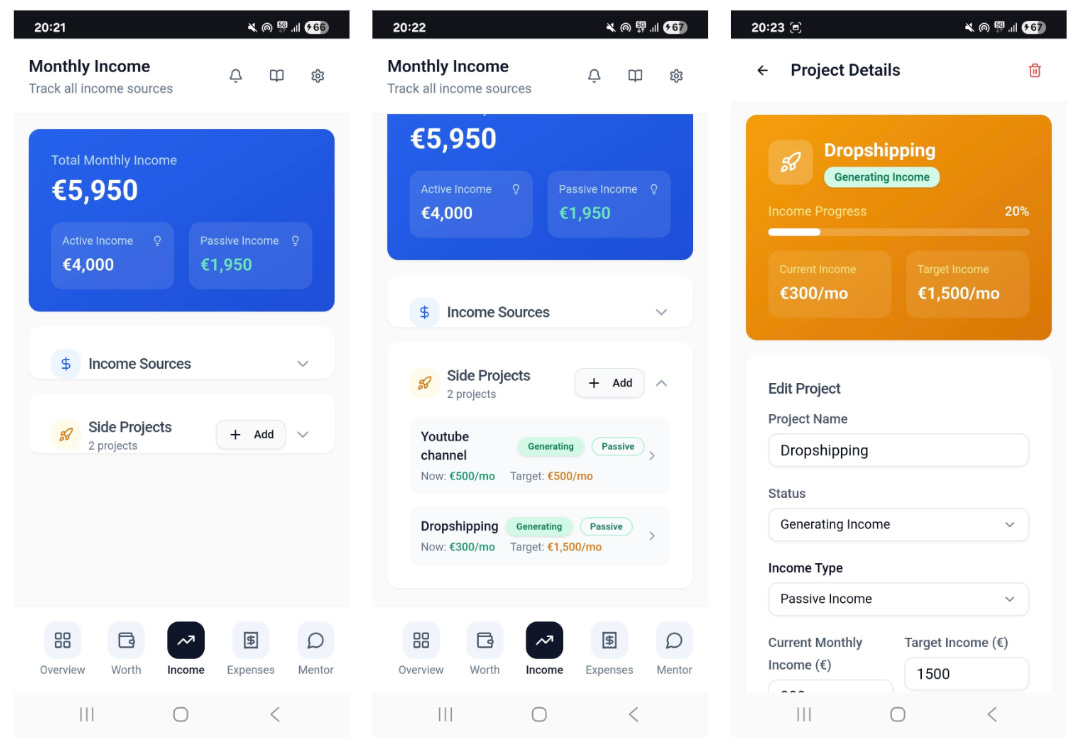
This is one reason I built the Financial Freedom Mentor app in the first place. I wanted to see my own financial life more clearly. Then I realized that if it helped me, it might help others too. That’s usually a good sign you’re onto something useful. In the Income Section you can track and manage all sorts of income and in particular the effectiveness of side projects.
Build fewer things, but build them well
The freedom portfolio is not about collecting side projects like trophies. It’s about building a small number of meaningful assets that support a freer life over time. That could be a tiny house rental, a van rental, a coaching program, a useful ebook, a digital product, an app, or something else entirely. The exact mix doesn’t matter as much as the philosophy behind it.
Choose projects that fit your skills, your joy, your leverage, and your principles. Keep the overhead low. Protect your focus. Track your time and money. And give the project long enough to compound before you judge it.
That is how you build a life that is not only richer in money, but most importantly richer in time, meaning, and room to breathe.
In a couple of days, I will launch the Financial Freedom Mentor on Product Hunt. I would really appreciate if you want to check it out there. If you like it, give it some love.
Feel free to leave a comment or a ❤️ below.