


One of the most difficult parts of building things is deciding when to let them go.
We often talk about minimalism in relation to physical possessions: fewer clothes, fewer gadgets, a smaller home, less clutter. But the same idea applies to businesses, projects, digital products, and ambitions.
A project can be valuable and still no longer belong on your priority list.
That is where I find myself with my Spartan Race Preparation Program, a digital training program I created to help athletes prepare for Spartan-style obstacle-course races. It is a project I am proud of. It works, it has helped users, and it contains far more than a simple PDF or a collection of workouts.
But I am selling it.
Not because I believe it has failed. Quite the opposite: I believe it deserves more focus, energy, and business-development effort than I can realistically give it today.
Here is a 4-minute video in which I describe what I am selling and why:
The rich minimalist approach
For me, being a “rich minimalist” has never meant owning nothing. It means being intentional about what I own, what I build, and where I direct my attention.
Time, energy, health, relationships, and mental clarity are forms of wealth. Often, they are more valuable than another income stream, another side project, or another item on a task list.
Entrepreneurs can be especially vulnerable to accumulation.
We accumulate ideas. We start projects. We buy domains. We build products. We see opportunities everywhere. Each individual initiative may make sense, but together they can create a life that is surprisingly complicated.
The result is not necessarily freedom.
Sometimes it is simply a more sophisticated form of clutter.
A business can become “digital clutter” when it is no longer aligned with your current priorities, but still occupies attention in the background. It may not demand much day-to-day work, yet it consumes mental space: updates to make, opportunities not pursued, messages unanswered, marketing that should be done, partnerships that could be explored.
Minimalism requires honest decisions.
You cannot do everything well. And you do not need to keep everything merely because you created it.
A project built from personal experience
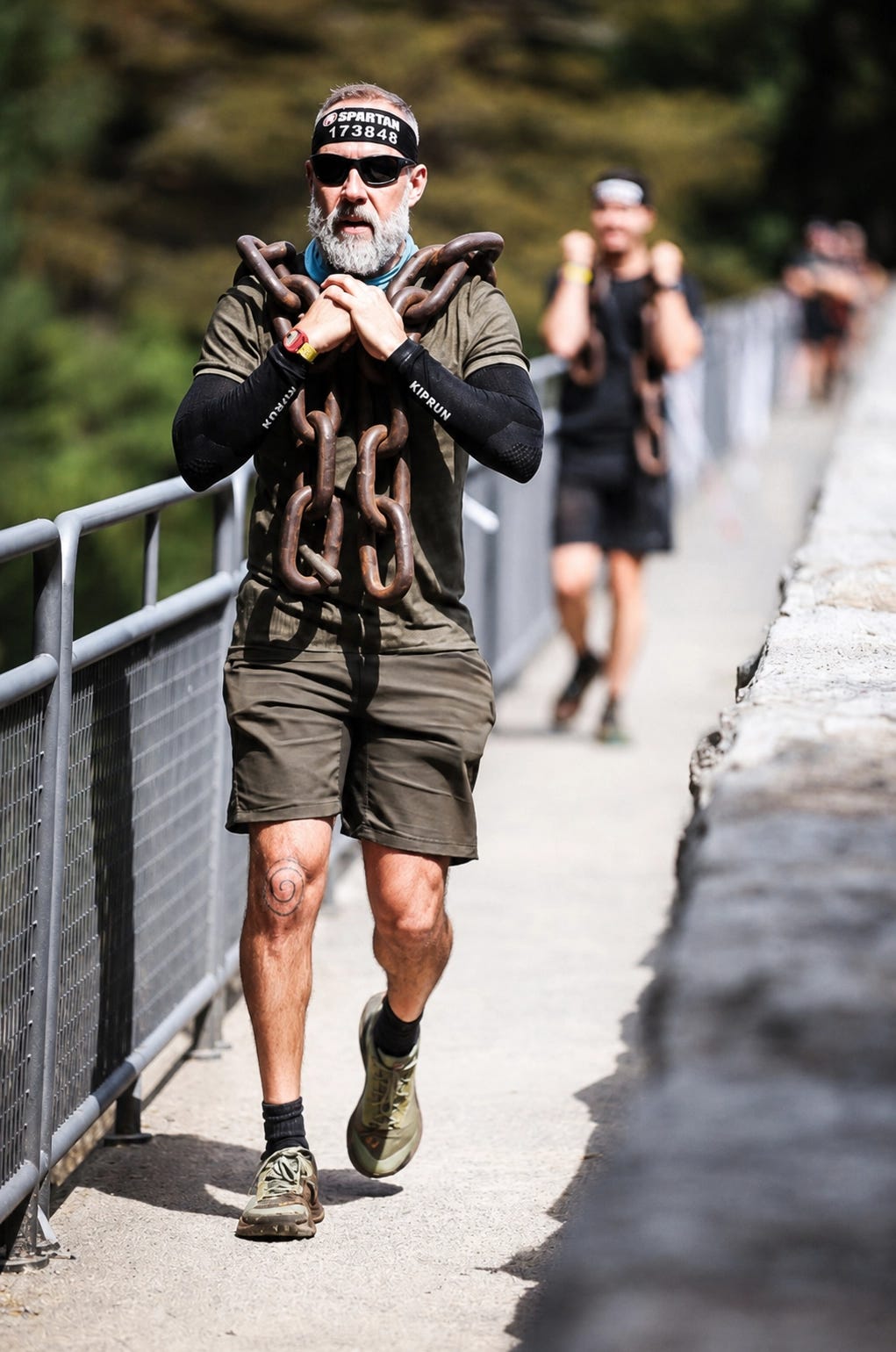
I created the Spartan Race Preparation Program because I am an obstacle-course-racing athlete myself. After completing ten OCR events, I saw a clear challenge for many participants: they had signed up for a race, but did not know how to prepare in a structured and specific way.
Running alone is not enough. Traditional gym training is not enough either.
Obstacle-course racing requires endurance, functional strength, grip strength, core stability, mental toughness, mobility, and the ability to deal with uncertainty, fatigue, mud, hills, obstacles, and discomfort.
That is why I built a structured 12-week training program designed specifically around race preparation.
The program includes workouts, exercise videos, a mobile-based training experience, guides, worksheets, nutrition advice, obstacle guidance, habit-building material, and mental-toughness content. It also includes an AI-based Ask-Me-Anything coach, giving users race-focused support whenever they need it.
Over time, the project became a complete digital business system rather than simply a training plan.
Built to be simple
One feature of the business that I particularly like is its automation. I built it with passive income capability in mind.
The customer journey can be structured to run with very little (or no) manual intervention: a customer discovers the product, purchases through Stripe, receives onboarding communication, accesses the program through PT Distinction, and follows the training journey inside the app.
That is the type of business model I find interesting.
Not because “passive income” means no work. It does not. Every real business requires responsibility, maintenance, customer care, and commercial thinking.
But a well-designed digital product can separate income from constant live delivery. It can create value for customers without demanding that the owner exchange every hour for revenue.
That is a powerful idea when approached responsibly.
A business that has clear systems, limited operational complexity, and automated fulfillment can give its owner more room to focus on health, family, creative work, meaningful projects, or simply time outdoors.
In other words, it can support a minimalist life rather than compete with it.
The opportunity needs a new owner
The most exciting opportunity is not necessarily rebuilding the product. The foundation already exists.
The opportunity is distribution.
Spartan-style races and other obstacle-course events attract a huge number of athletes every year. Preparing for an event is a natural moment to offer a structured training program. The product could be marketed directly to athletes, but it could also be positioned through coaches, gyms, endurance communities, affiliates, local event partners, and race organisers.
Imagine an athlete registering for an event and being offered a practical, structured preparation plan as an optional add-on.
It is a complementary product. The athlete wants to feel prepared, confident, and capable on race day. The organiser, coach, or partner can offer additional value. And the training program can be delivered automatically.
There is a massive opportunity, which is basically the last business development step that I never got to properly: setting up a collaboration with the bit event organizers who want to co-sell my program.
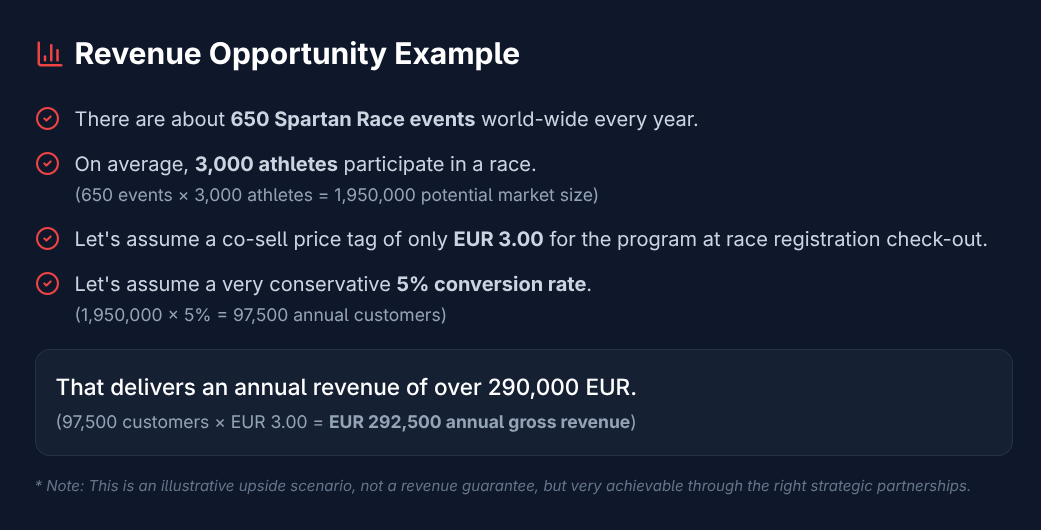
Here is a simple calculation:
There are about 650 Spartan Race events world-wide every year.
On average, 3,000 athletes participate in a race.
Let’s assume a co-sell price tag of only EUR 3.00 for the program at race registration check-out.
Let’s assume a very conservative 5% conversion rate.
That delivers an annual revenue of over 290,000 EUR.
Of course, this is an illustrative upside scenario, not a revenue guarantee, but very achievable through the right strategic partnerships.
This is a commercial opportunity, but it is also a useful one. Better-prepared athletes may enjoy the experience more, feel less intimidated by the event, and arrive with more confidence.
Letting go without regret
Selling this project is an exercise in the same principle I try to apply elsewhere in life: keep what matters most, and do it properly.
I could hold on to my Spartan Race Preparation project longer. I could tell myself that I will return to it “when things become quieter” and complete this final biz dev step of setting up partnerships. But entrepreneurs know that things rarely become quieter by accident.
Clarity requires action.
The program deserves an owner who wants to develop partnerships, and take the next commercial step. I cannot offer it the attention it deserves while remaining committed to my other businesses and projects.
So I am choosing focus over accumulation.
The full sale includes the brand, domain, website, training program, exercise content, source code, automated workflows, Stripe payment integration, PT Distinction setup, AI coaching bot, guides, worksheets, and transition support. There is also a substantial audience of email contacts, subject to an appropriate re-permission process under a new owner.
If you are a fitness entrepreneur, coach, race organiser, digital-product operator, or someone who sees potential in a simple, automated business with a useful purpose, click the button below to request more information: