


If you’ve read my FIRE guide from January, you already know the math: your FIRE number is 25 times your annual expenses. Lower that number, and freedom arrives faster. Reduce it dramatically, and freedom arrives soon.
That’s where minimalism stops being a bedroom aesthetic and becomes a financial weapon.
It’s not about wearing potato sacks or eating ramen forever. It’s about designing a life where your fixed costs (=the silent thieves of time and freedom) are so low that even a modest income (or side projects) carries you across the finish line. Tiny house instead of mortgage. Bike instead of car payment. Fewer subscriptions, simpler meals, less maintenance. Each cut compounds into years of your life.
Let me show you how this plays out in real numbers and real life, from my own tiny house experiment and the Financial Freedom Mentor app I’ve built to make this visible.
The fixed cost trap most people never escape
Your biggest expenses aren’t the random Amazon splurges or that one big vacation. They’re the recurring costs that own you month after month: rent/mortgage, car payments, insurance, utilities, subscriptions, storage units for stuff you never use.
A typical city apartment dweller might spend monthly:
€1,200 rent
€400 car + insurance
€200 utilities/internet
€150 subscriptions + misc
That’s €1,950/month just to “exist.” At 25x, you’re €585,000 away from freedom. Even with a solid income, that feels like a life sentence.
Now picture this minimalist baseline:
€400 tiny house (owned outright or low mortgage)
€0 car (bike/public transport)
€50 insurance
€30 basic internet
€50 minimal subscriptions
€530/month. Your FIRE number drops to €159,000. Same income, same savings rate, but freedom arrives three and a half times faster.
The gap between those two lives? Not suffering. Intentional subtraction. Minimalism doesn’t make you poorer. It makes freedom cheaper.
Tiny house vs. big mortgage: the numbers don’t lie
My Viking Tiny House Berkana Othala cost a fraction of a city apartment deposit. No massive mortgage. No property taxes eating 1-2% yearly. No heating bills for 200m² you barely use.
Living small means:
Less maintenance. No lawn to mow, no garage to organize, no second bathroom to clean.
Lower utilities. Solar covers most needs. Wood stove for winter. Propane for cooking/shower.
No “space creep.” You don’t buy more stuff because there’s no room for it.
In my FIRE article, I used €40,000/year as a minimalist baseline. With a tiny house, you can hit €24,000/year and still eat well, travel seasonally, and invest aggressively. That’s a 40% smaller FIRE number. If you’re saving €1,000/month now, you shave six years off your timeline.
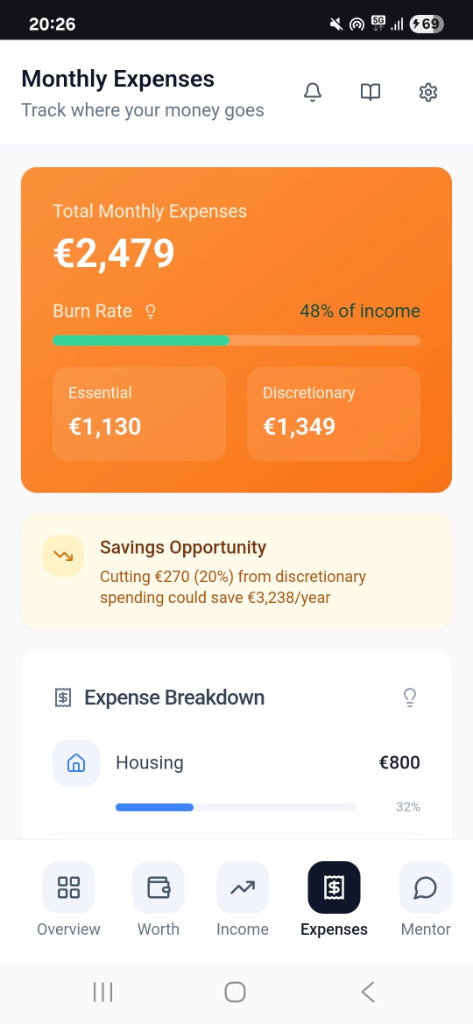
The app shows this instantly: modify your current expenses with respect to experimental changes and watch your freedom date jump forward.
Car vs. bike: freedom or payments?
Cars are the perfect minimalism target. Most people don’t need one daily. They need the feeling of optionality. But that €400/month payment (plus insurance, fuel, parking, repairs) is a freedom anchor.
Depending on where you live, getting rid of a car is not always feasible. But downgrading is feasible. Or just get a shit, cheap, reliable car which you don’t care about.
If you reduce your car related cost by €380/month, then the FIRE impact is €114,000 less to save. Nearly two years faster.
The mental shift is huge too. No parking stress. No “is this dent covered?” anxiety. More movement baked into the day.
The app audit might reveal: “€4,800/year on wheels you use 3 days a week.” Redirect half to investments, and compound interest does the rest.
Subscriptions vs. sovereignty
The average person pays €100-200/month for Netflix, Spotify, gym memberships, apps, cloud storage—most barely used. Minimalism asks: “Does this serve my freedom or just fill silence?”
I run lean:
No paid music service
Substack (free creativity)
Basic cloud for work
I do pay for Crossfit classes because health and fitness are my priority.
If you can reclaim €900/year, over 25 years at 7% return? €47,000. Almost enough for a whole tiny house or years of semi-retirement runway.
The app’s “Freedom Date” feature gives you a visual cue how far or close you are to financial freedom.

Simpler meals, bigger freedom
Food is where minimalism meets health. I cook simply: eggs from neighbors, soon homegrown greens, bulk shopping, or seasonal market produce. €300/month, delicious, nutrient-dense.
Contrast with delivery apps, or pre-made meals: €600-800/month easy.
Savings: €300/month = €9,000/year = €225,000 FIRE impact.
Two decades faster.
Minimalist eating isn’t deprivation. It’s intentional: fewer decisions, less waste, better fuel for training and focus.
It is also an act of balance. Because sometimes I do eat out. Sometimes it’s necessary and it’s all about the right balance.
The time richness multiplier
Money freedom is the goal, but time richness is the reward. Minimalism doesn’t just lower costs—it frees hours.
Tiny house = 10 hours/week less cleaning/maintenance
No car = 5 hours/week less driving/errands
Fewer subscriptions = 3 hours/week less “content overwhelm”
Simple meals = 7 hours/week less shopping/planning
No time wasting people around = priceless
25 hours/week = a full-time job reclaimed.
That’s time for passion projects (aSubstack, a new app idea), training (hill sprints, pull-ups), relationships, reading, studying or just staring at mountains. Time you can’t buy back once it’s spent.
The passion project accelerator
Lower costs + more time = perfect conditions for side projects that can become passive income—the holy grail of financial freedom. With a €24k/year baseline, you don’t need €100k salary to invest aggressively. €2-3k/month savings compounds fast.
One branch on my own path: engineer → corporate sales → tiny house + writing + building → Financial Freedom Mentor app. Each step leveraged the last. Lower costs funded the risk. More time built the skill.
Your “freedom surplus” (savings beyond necessities) becomes rocket fuel for:
Digital products (ebooks, courses, apps)
Rental income (tiny house or Airbnbs)
Dividend portfolios
Skill businesses (coaching, consulting)
Angel investing
The app forecasts this encourages to change habits via Money Micro Lessons and Passive Income project monitoring.
Making the shift: three steps
Audit ruthlessly. Tag every expense: Freedom (health, growth), Neutral (basic needs), Noise (status, distraction). Cut 80% of Noise.
Replace, don’t just delete. Car → e-bike rental. Subscriptions → library + free tools. Big kitchen → one perfect knife + cast iron.
Test for 90 days. Track time gained, money saved, freedom felt. Adjust. Minimalism compounds through iteration.
The numbers speak
Below is just an example but it’s realistic and useful to make a point.
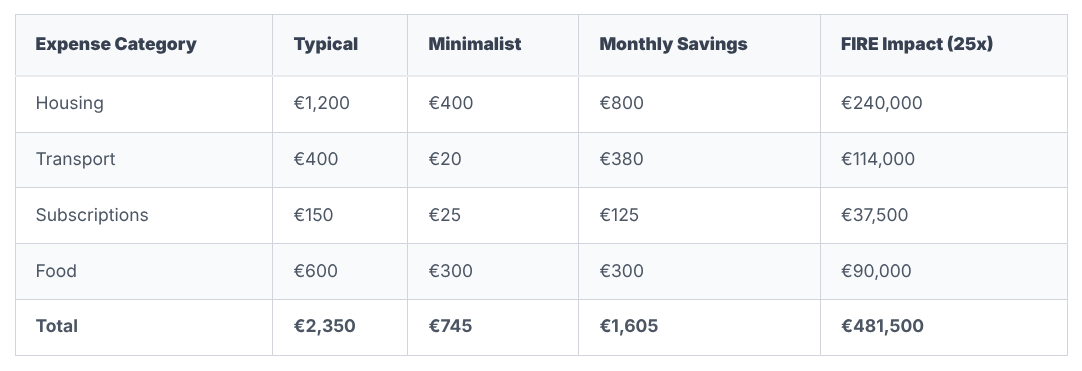
€481k less to save. 13+ years faster to freedom.
That’s not theory. That’s my life. That’s what the app models for thousands of users.
Your time-rich life starts now
Minimalism isn’t anti-money. It’s pro-freedom.
Every fixed cost you eliminate is a brick removed from your personal prison. Every hour reclaimed is a deposit in your time bank.
You don’t need to go full tiny house tomorrow. Pick one category. Audit it. Cut 30%. Feel the air come back into your lungs.
If you’re ready to turn “stuff-rich” into “time-rich,” subscribe to The Rich Minimalist. More minimalist money moves, tiny house experiments, and freedom math—straight from the mountains.