

Water is one of those things most people only think about when it stops working.
In the city, you turn on the tap and water appears. You flush the toilet and it disappears. You shower, wash dishes, water plants, and hardly ever ask where any of it comes from. In a tiny house, especially an off-grid tiny house in the mountains, that kind of invisibility disappears very quickly. Water becomes something real again. Something limited. Something that needs to be understood, respected, collected, stored, filtered, and used carefully. In fact, my most important ongoing challenge.
That change, however, is actually one of the greatest gifts of living this way.
When you live off-grid, water is no longer just a utility. It becomes part of your daily awareness. You start noticing rain forecasts like a farmer. You become more water-aware again and connected. You think about roof surfaces, tank capacity, pump pressure, filter stages, and shower habits. You become much more deliberate, and that deliberate living tends to spill into the rest of your life too. You waste less. You pay attention more. You stop assuming abundance and start creating it.
This is especially true in my tiny house in north-east Catalonia, in the Pyrenees, where the average rainfall is about 600 mm per year. That is enough to make rainwater harvesting not just possible, but very practical. In fact, once you understand the math, you realize that your roof is a surprisingly productive little water factory.
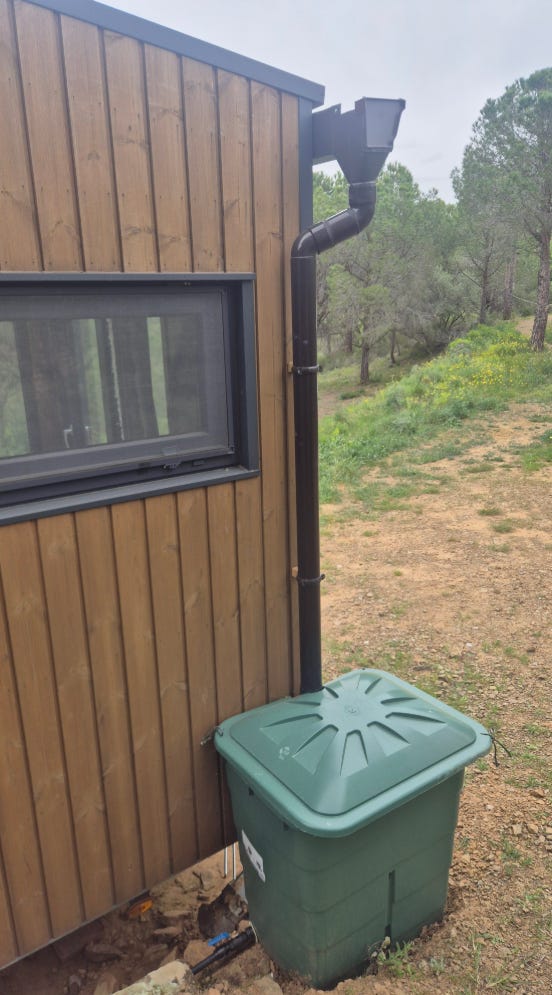
Water Sources for an Off-Grid Tiny House
Before going into my own system, it helps to understand the different water sources available to someone living off-grid. Most tiny houses do not rely on a single source. They work best when they combine a few options, because nature rarely behaves in a perfectly consistent way.
The first and most obvious source is rainwater. If you have roof surface, rain is free water falling from the sky, and in many off-grid setups it is the most elegant solution. It requires infrastructure, yes, but once the system is built, it is beautifully simple. And it makes you independent at no extra cost. Water lands on the roof, flows into a tank, gets filtered, and can be used for washing, showering, dishes, and sometimes even drinking if the filtration system is adequate and properly maintained.
The second source is transported water. This is the backup when rain is not enough. In my case, during summer months with very little rainfall, I bring water to the land and fill the tanks using the 100-liter fresh water tank of my camper van. It is not as romantic as rainwater, but it is very practical. Off-grid life is not about purity tests. It is about having a system that works.
A third possible source for some tiny houses is a well or spring. If you are lucky enough to have one on your land, this can be an excellent source of water. But wells bring their own issues: pumps, permits, maintenance, seasonal variation, and water quality testing. Digging a well can be super expensive. Springs can be wonderful too, but they are often location-specific and not always reliable year-round.
Some people also use municipal water while still living in a tiny house, especially if the house is not fully off-grid. That can make sense as a transitional setup. It reduces complexity, but it also reduces independence. For me, the appeal of off-grid living is to reduce reliance on systems I don’t control, so rainwater is the main story.
And finally, there is the most important source of all: water discipline. You can have all the infrastructure in the world, but if you consume carelessly, you will still run dry.
In a tiny house, water habits matter almost as much as water supply.
Why Rainwater Harvesting Works So Well Here
I live in a place where the annual rainfall is around 600 mm. That means, in simple terms, that every square meter of roof can theoretically collect about 600 liters of water per year.
My total roof surface is 24.7 m2, made up of 16.9 m2 of tiny house roof and 7.8 m2 of shed roof. Multiply that by the annual rainfall and you get roughly 14,820 liters per year. Dividing that over 365 days gives an average of about 40 liters per day.
That number is both encouraging and humbling.
It is encouraging because it shows that a relatively small roof can collect a meaningful amount of water. And it is humbling because average numbers can be misleading. Water does not arrive evenly. Some months bring plenty. In October I can get 63.5 liters per square meter—on average and in theory. In June I might get only 17.8 liters per square meter. That means I need to think seasonally, not just annually.
In addition, even though I may have months where I can collect more water, I also need a good way to store water, like big enough deposits and so that the water doesn’t turn bad (no sun exposure etc). And of course, in those summer months when I get less water, I need more (showers for instance).
This is where off-grid living teaches you to become a strategist. You don’t just ask, “How much water can I get?” You ask, “When do I get it, where do I store it, and how do I stretch it through the dry periods?”
My Real-World Water Use
One of the biggest changes in my life has been learning to use much less water. I now live on around 10 to 20 liters per day, and that includes daily showers. I also combine this, for example, when I go to the next town for a Crossfit workout—then I usually shower there.
That is a big contrast to normal urban life, where a single person can easily use 100 liters or more per day without thinking about it. But once you start paying attention, you discover that most of that usage is not essential. It is habit.
My shower routine is a good example. I always shower cold, which means—apart from the health benefits—I am much faster and typically only need about 8 liters per shower. That makes a huge difference. I am not standing there wasting warm water for ten minutes while daydreaming about my to-do list. I get in, wash, get out, and move on with my day.
My toilet is a dry toilet, so it does not use water at all. That alone saves a surprising amount of consumption. It also simplifies the plumbing system and reduces the need for ongoing water just to deal with waste.
This is why the whole setup works. The source is not enough by itself. The source and the usage need to match. If you want to live on rainwater, your habits need to support that reality.
How My DIY Rainwater System Works
My system is simple, but simple does not mean primitive. In fact, one of the best things about tiny house infrastructure is that small, smart systems can work very well if they are designed with care.
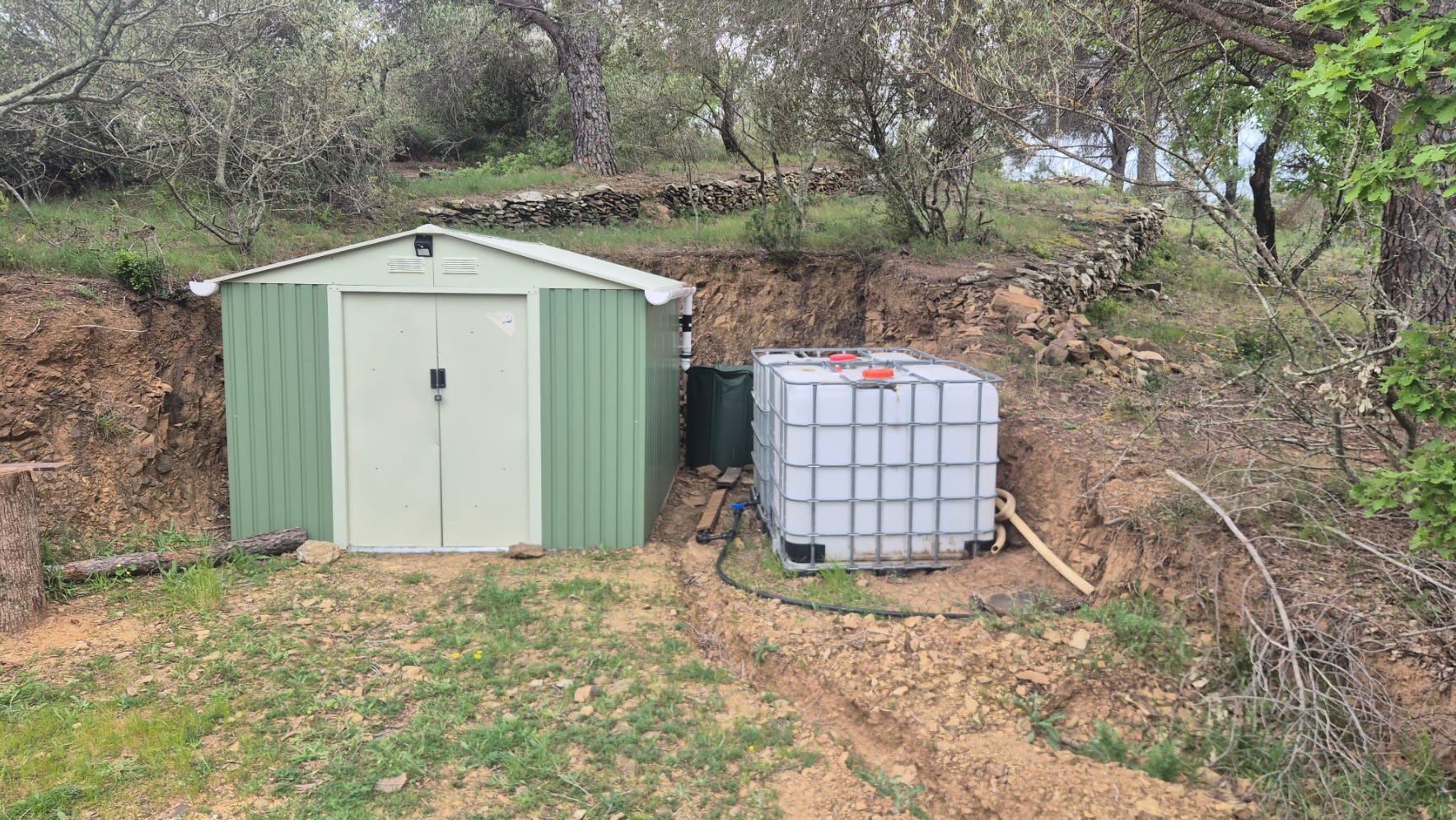
Rainwater falls onto the roofs of the tiny house and shed. It’s collected in gutters and from there it enters the collection system and is routed into various deposits or tanks. I have several tanks, and I can add or remove them from the circuit individually depending on the season, the water level, and what I need at the time.
That flexibility is important. It means I can adapt the system rather than forcing the weather to fit my life. In wetter periods, I can store more. In drier periods, I can use a smaller active setup and simplify the circuit. The system is modular, and that is one of the reasons it works well in practice.
After collection, the rainwater passes through my DIY filter setup. I built the filters myself, and they are designed to remove the kinds of particles and impurities that naturally come with roof runoff. You can see the basic idea in the photo below.
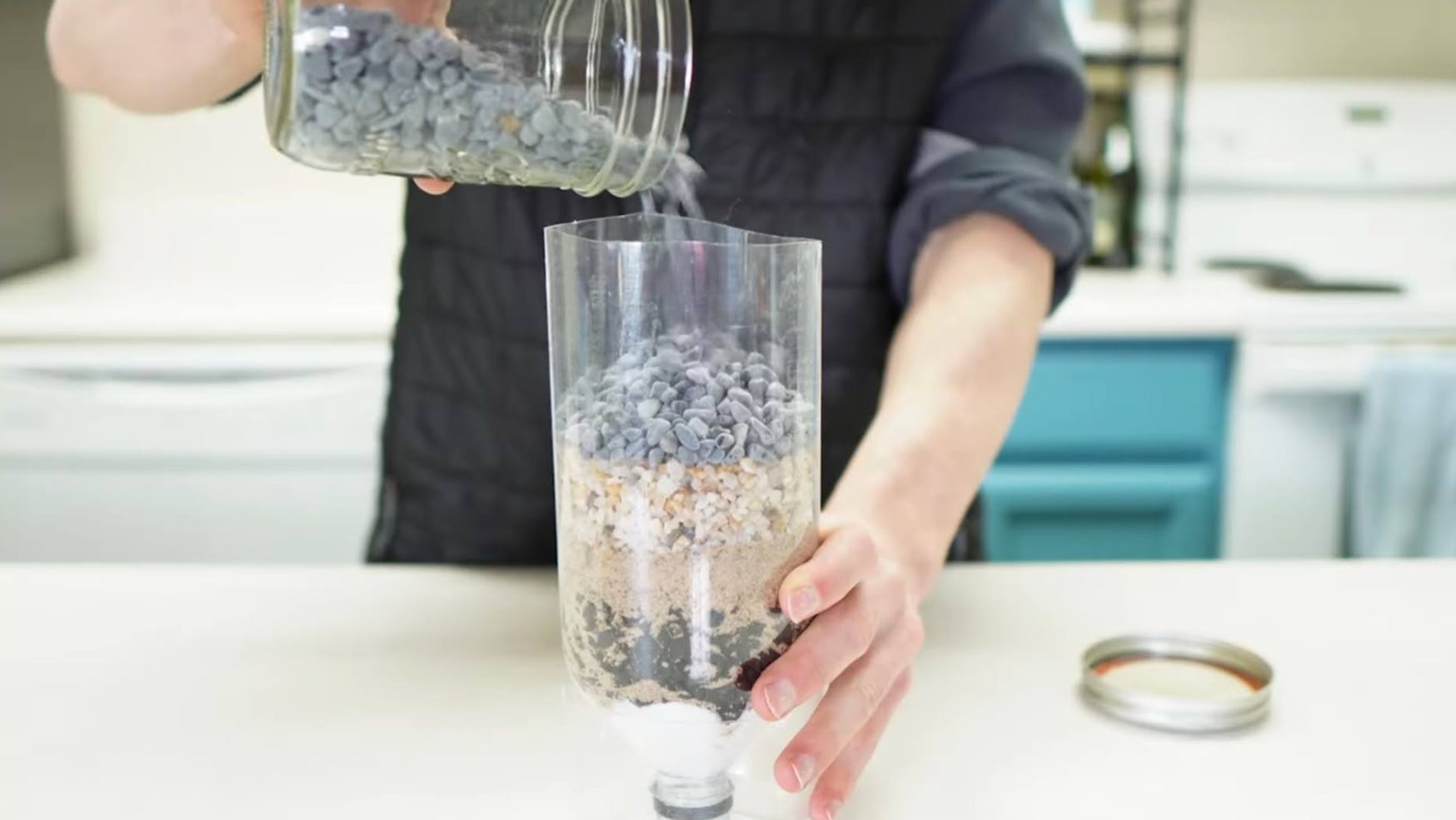
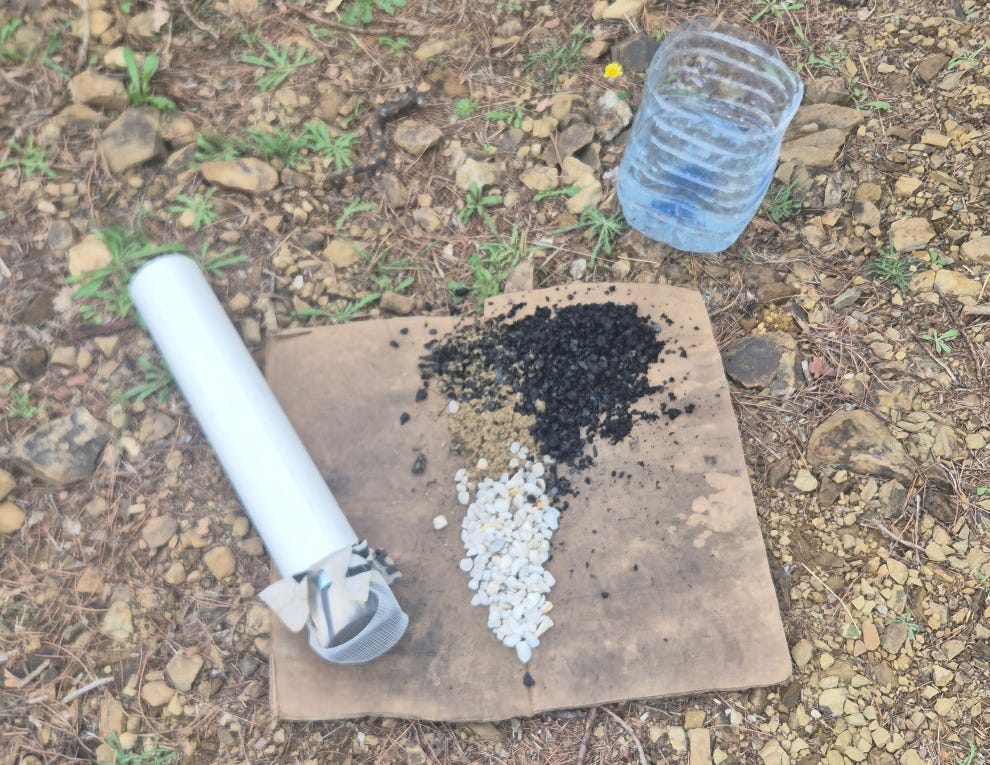
It’s a layered filtration system, physical filtering, and a practical, handmade approach that fits the tiny house mindset. I also have an additional filter on the tap, which gives me a second layer of protection before water is used inside the house. I use the faucet filters from Tappwater with their five-stage nanofiltration.
That double-filter approach is important because no roof collection system is perfect. Leaves, dust, fine particles, insects, and all kinds of mountain debris can find their way into the water path. Filtration is what turns collected rain into usable water.
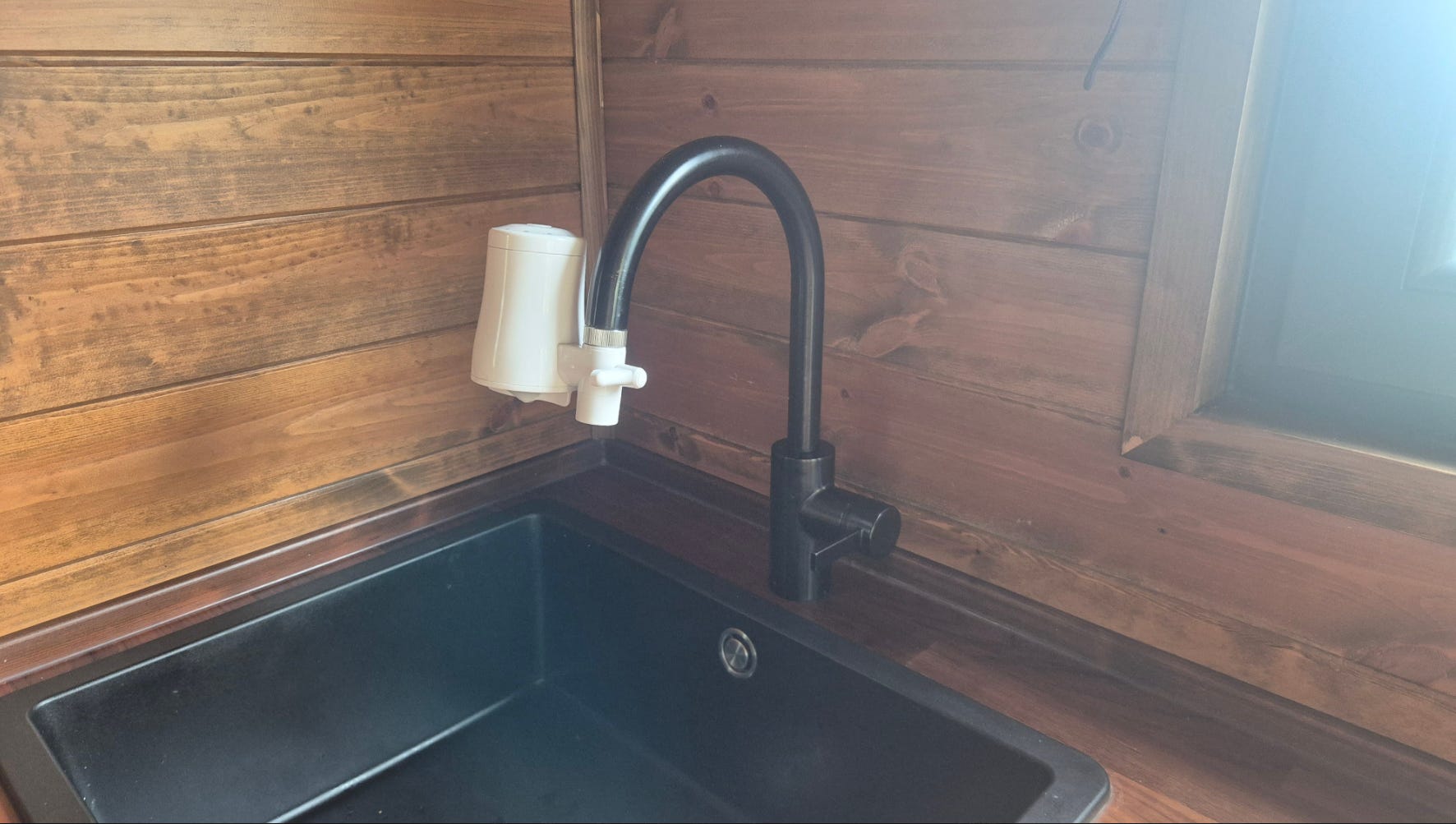
It is still not drinking water. But it is safe enough to use for cleaning the dishing, shower, or brushing teeth. Drinking water I need to buy in normally eight liter canisters when I do my shopping run anyway.
Pumping Water into the House
Once the water is collected and filtered, it needs to get into the house. For that, I use a simple outdoor pump that is normally sold for garden watering systems. It is not fancy, and that is exactly why I like it. It does the job without overcomplicating the setup.
This is another principle I try to follow in off-grid living: use ordinary tools in smart ways. Whatever does the job. This pump cost me EUR 120.- Proper “house pumps” are more like EUR 1000,- or more. You do not always need specialized, expensive equipment. Sometimes a garden pump is perfectly fine for tiny house use, as long as the flow rate, pressure, and durability are enough for the system. It’s waterproof so it can just sit outside just under the tiny house
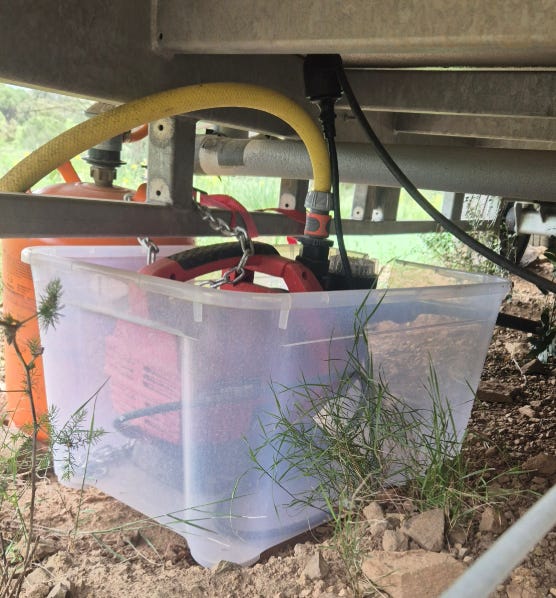
.The water gets pumped into the house and can then be used through the tap, the shower, and the rest of the internal setup. Because I already keep my consumption low, the pressure on the system stays manageable. That is the beauty of low-demand living: the whole infrastructure can stay simpler and more robust.
What the Dry Months Change
The most interesting challenge is not when it rains. It is when it doesn’t.
Summer forces me to think ahead. I need to supplement water by bringing it to the land using my camper van tank. That means I can’t be lazy with my usage. If I waste water in June, I pay for it later. If I use water consciously in April and May, I buy myself more margin in July and August.
This is where the idea of planning and resilience becomes very real. Rainwater harvesting is not just about collecting free water. It is about designing a lifestyle that can absorb variation. A good off-grid system does not pretend that every month will be equal. It prepares for imbalance.
And that is a useful lesson beyond water too. Whether it is money, energy, food, or attention, a good minimalist system is one that can handle dry seasons.
Why This Matters Beyond Plumbing
A lot of people think off-grid systems are interesting because they are technical. I think they are interesting because they are philosophical.
When you build your own water system, you are forced to answer important questions. How much water do I really need? What is enough? What can I do without? How do I make the system elegant, easy-to-use, and robust instead of bloated or fancy? How do I stay comfortable without becoming wasteful?
Those are not just plumbing questions. They are life questions.
Rainwater harvesting has made me more careful, more grateful, and much more aware of how much abundance can come from a simple roof and a bit of planning. It has also made me more independent. I know where my water comes from. I know how it moves. I know what happens when the sky gives more or less. That awareness is powerful.
Living this way does not mean living with less meaning. It means living with more contact with nature, with reality.
And honestly, that is one of the best things about the tiny house life.
If this kind of practical approach to tiny house living, minimalism, and self-sufficiency resonates with you, consider subscribing to The Rich Minimalist. It’s free. I’ll keep sharing small, realistic shifts that move you closer to a life that’s lighter, freer, and a lot more yours.
Or just leave a comment or a ❤️