

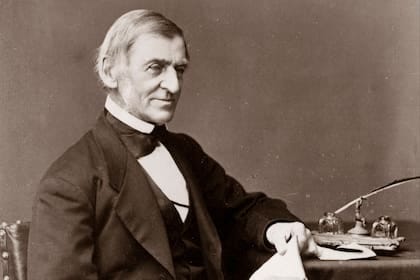
Ralph Waldo Emerson’s timeless essays like “Self-Reliance” and “Nature” champion trusting your inner voice, embracing simplicity in the natural world, and rejecting conformity. This is also in line with the core principles that I represent and advocate, powering the deliberate, off-grid life of The Rich Minimalist.
The Man Who Ignited American Thought
Ralph Waldo Emerson (1803-1882) was no hermit philosopher lecturing from ivory towers. Born in Boston to a line of ministers, he trained as a Unitarian clergyman but resigned in 1832, rejecting dogma for personal spiritual experience. Settling in Concord, Massachusetts, he became the intellectual spark of Transcendentalism—a movement stressing individual intuition, nature’s divinity, and self-reliance over institutions.
His home hosted thinkers like Thoreau, whom he mentored, and his lectures drew crowds hungry for ideas amid America’s industrial churn. Emerson’s prose, poetic yet punchy, turned everyday truths into revolutions, influencing everyone from Walt Whitman to modern minimalists.
Emerson’s life embodied his teachings: after losing his first wife, he traveled Europe, absorbing Romanticism and Eastern thought, then poured it into essays originally delivered as talks. His fertile 1830s-1840s produced Nature (1836), Essays: First Series (1841), and Essays: Second Series (1844) These are cornerstones blending philosophy, poetry, and ethics. Later works like Representative Men (1850) profiled greats from Plato to Napoleon, while The Conduct of Life (1860) grappled with fate and limitation. By his death, Emerson had shaped American individualism, urging souls to break free from “quiet desperation.”
Key Works: Emerson’s Intellectual Fireworks
Emerson’s breakthrough, Nature, declares the woods a gateway to the divine:
“In the woods, we return to reason and faith.”
It fuses pantheism—God in all things—with calls to “stand on your own feet,” rejecting society’s “fossilized” customs.
His Phi Beta Kappa speech, “The American Scholar” (1837), dubs scholars “divine men” educated by nature, books, and action, not mimicry—America’s intellectual Declaration of Independence.
Essays: First Series shines with “Self-Reliance,” a minimalist manifesto: “Trust thyself: every heart vibrates to that iron string.” He skewers conformity: ”Whoso would be a man must be a nonconformist” and envy, insisting genius is universal if we shed societal scripts. “Compensation” reveals life’s balance: gain virtue, lose vice. “The Over-Soul” posits a universal spirit linking all souls, dissolving ego in cosmic unity. These are all chapters in Essays: First Series.
Second Series adds “Circles” (life’s expanding rings of growth), “The Poet” (artists as nature’s interpreters), and “Experience” (embracing life’s ambiguities). Later, Society and Solitude (1870) explores friendship’s quiet power.

Core Insights: Self, Soul, and Simplicity
Emerson’s genius lies in radical optimism: humans hold infinite potential, but society smothers it with imitation.
Self-reliance demands trusting your “aboriginal Self”—inner genius—over crowds or creeds: “Nothing is at last sacred but the integrity of your own mind.”
Nature heals. It teaches laws mirroring the soul’s. Simplicity often brings insight.
The Over-Soul unites us in a divine web, urging nonconformity for collective elevation.
Finally, fate bows to character: polish your tools (mind, body, virtue), and circumstance serves you.
These brings some clarity, which we often don’t see: wealth without soul is poverty; busyness without purpose, desperation.
Emerson anticipates minimalism—possess little, live much.
Emerson and The Rich Minimalist: Echoes of Walden
Emerson mentored Thoreau, lending him the Walden Pond land, where he created most of this body of work. The core message resonates very well with The Rich Minimalist: freedom through less. His call to “simplify, simplify” (via Thoreau) aligns with off-grid ethos. No need for excess, leverage the richness that just nature gives us. For free, we just need to open our eyes.
The nature is our classroom.
Live off-grid and you quickly tune into the seasons—when to work, when to rest, and how little you actually need. Emerson’s idea of compensation reminds you to avoid debt traps: pay things off, own what you use, and travel light so no bank owns your freedom.
His Over-Soul points to something bigger than the individual, so even if you live remotely, you can still build a small tribe of people who share your values. In a noisy consumer world, his nonconformity is a filter: instead of asking “what should I buy?” ask “what actually fits me?” A rich minimalist life is simply this in practice: keep only what truly serves you and your purpose, and protect huge amounts of inner and outer space.
Practical Lessons: Emerson for Modern Minimalists
Emerson can be a little abstract. But he is also actionable. I tried to distill some core lessons from his work that also resonated with me and The Rich Minimalist ideas:
Lesson 1: Audit Imitation.
Take out a journal and conduct a thorough audit of your daily habits, purchases, and even the content you consume. Ask yourself plainly which of these stem from copying others rather than serving your unique path, then ruthlessly eliminate the envy-driven buys and social media scrolls that keep you tethered to someone else's version of success, reclaiming the sovereign "mind of your own" that Emerson insists is the foundation of a truly free life.
Lesson 2: Nature Immersion.
Commit to daily walks without your phone, letting your eyes and ears attune to the unhurried rhythm of the natural world just as Emerson urged us to "adopt the pace of nature: her secret is patience," and if you're already living off-grid like I do in the mountains, deepen this practice by tending a small garden, chopping wood by hand, or simply watching the stars emerge each night. These unmediated encounters with earth build a profound inner resilience that no gym or app ever could.
Lesson 3: Iron String Trust
When facing any major decision—whether to stay in a soul-draining job or launch something new—trust that inner “iron string” of conviction that Emerson describes, stepping away from endless advice-seeking or committee approvals to speak your latent truth boldly, as I did when I decided to pivot from corporate work to side hustles, investing, ebooks, coaching, and other projects, discovering that real progress only happens when you honor your own unfiltered instincts over the crowd’s cautious consensus.
Lesson 4: Compensation Practice
Emerson’s principle of compensation teaches that every gain carries a hidden loss, so pause before every potential acquisition or commitment—like trading hard-earned freedom for debt-fueled status symbols—and deliberately weigh the long-term costs against the fleeting gains, choosing instead the path of radical mobility and rock-bottom expenses that lets you own your tiny house outright, travel light across borders, and sidestep the invisible chains that trap most people in endless financial servitude.
Lesson 5: Circles Expansion
Recognizing that Emerson saw life as expanding circles of understanding, make it a yearly ritual to audit your beliefs, possessions, and pursuits with fresh eyes, courageously shedding what once served you but now stagnates—like outdated gear cluttering your van or rigid routines that no longer fit your evolving freedom—and embrace the discomfort of change as the signal that you’re growing into wider, more authentic orbits of living.
Lesson 6: Over-Soul Connection
Emerson’s Over-Soul reminds us that solitude fuels genuine connection, so carve out time for aloneness in nature or quiet reflection, then channel that inner clarity outward by hosting simple fireside gatherings with fellow travelers—off-grid friends, FIRE seekers, or minimalist creators—where you share hard-won wisdom around a fire, forging a tribe bound not by proximity or obligation but by shared reverence for something larger than individual striving.
Lesson 7: Poet Within
Awaken the poet within by creating without apology—whether that’s filling a journal with raw thoughts on your latest hill sprints, carving a spoon from wood, penning a short poem about the stark beauty of your tiny house at dawn, or building something else tangible with your hands. Emerson knew that this act of making unlocks the latent genius in all of us, turning minimalist constraints into a canvas for the most authentic expression of your soul.
Emerson’s Enduring Call: Live Your Divinity
Emerson shows that real richness grows from within: people who rely on themselves, sync with nature, buck the crowd but stay connected to others, and thrive even in chaos.
For us Rich Minimalists, he’s like a guiding saint—tiny houses, off-grid living, and connecting with nature unlock your inner self while respecting nature’s rules. Stop chasing desperately; start connecting deeper.
Subscribe to The Rich Minimalist for more philosophical as well as practical topics around minimalism and intentional living.
Or just leave a comment or a ❤️