


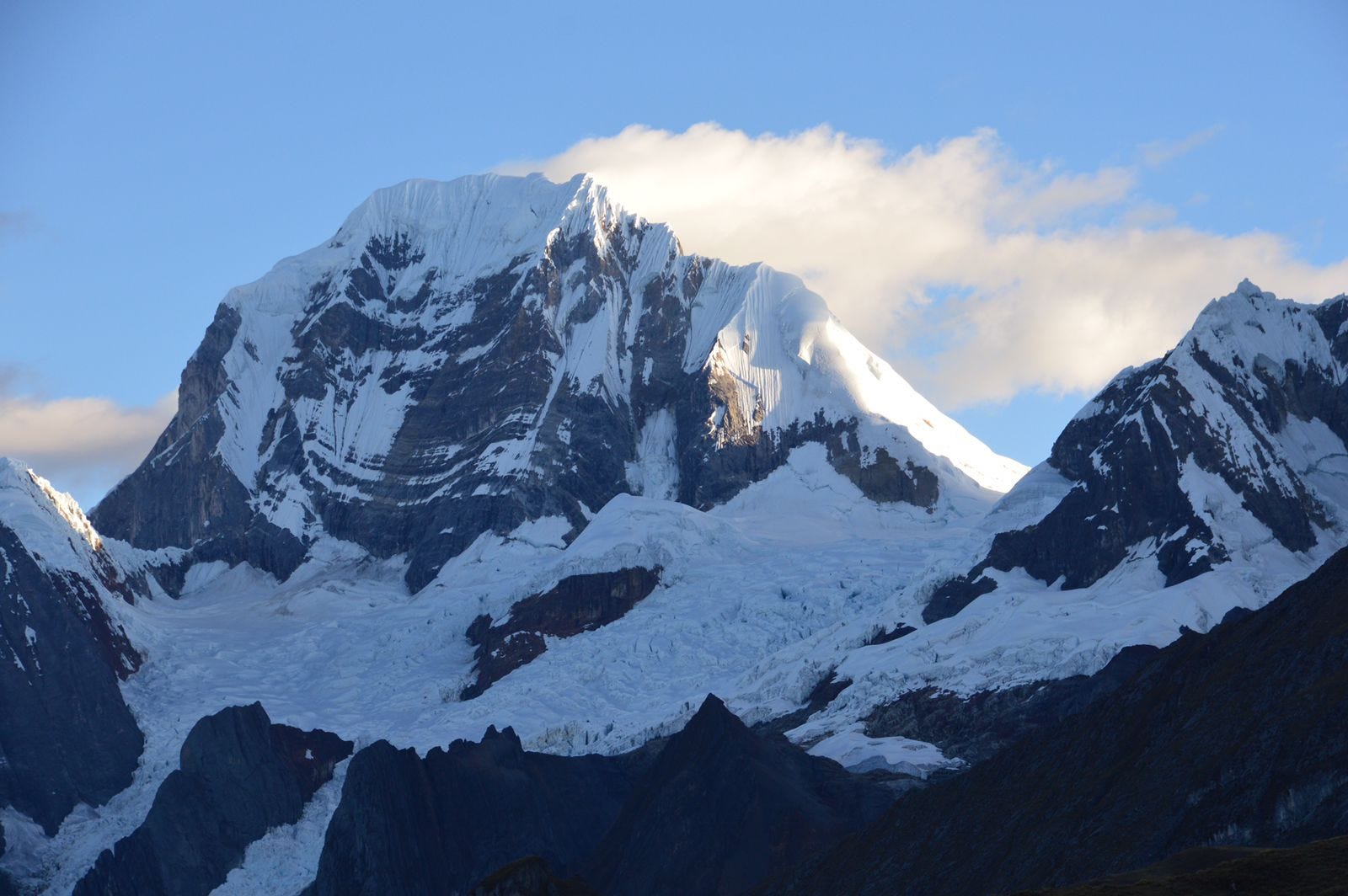
When Joe Simpson and Simon Yates set out to climb Siula Grande, a remote 6,344-meter peak in the Peruvian Andes in 1985, they knew it was a first-ever winter ascent. What they didn’t anticipate was one of the most harrowing survival stories ever told—one that strips life down to its absolute minimum and reveals what it takes to keep going when everything is lost.
This isn’t just a mountaineering tale. It’s a masterclass in minimalist survival: how to function with zero gear, no food, shattered bones, and no hope, using only your body, mind, and the simplest possible decisions. For anyone chasing health, freedom, or a simpler life, Simpson’s story carries lessons that go far beyond the mountain.
The climb goes wrong fast
Siula Grande was remote, technical, and unclimbed in winter for good reason. The two Brits pushed hard, reached the summit, but disaster struck on the descent. Simpson slipped, fell, and shattered his right leg. Tibia and fibula snapped clean through in sub-zero conditions.
They were still high on the mountain, miles from base camp, with no helicopter rescue possible. Yates did the only ethical thing: he tried to lower Simpson down the glacier using ropes. But when Simpson went over a cliff edge and hung suspended in a crevasse—too heavy to pull up, too injured to climb—Yates made the hardest call imaginable. With both their lives on the line, he cut the rope.
Simpson dropped into darkness, 50 feet down into an ice cave system. Yates, believing his friend dead, descended alone to base camp.
Zero to survival: the crawl begins
What happened next defies normal human limits.
Simpson didn’t die. He landed on a snow ledge inside the crevasse, assessed his broken leg, and realized he had two choices: stay and perish, or move. With no food, no water, no shelter, and a leg that barely functioned, he began crawling.
For the next three days, Simpson dragged himself across glacier, rock, and boulder fields toward base camp—about 8 kilometers over brutal terrain. His right leg was useless, held together only by willpower. He had no gear left except the clothes on his back and an ice axe. No tent, no stove, no first aid.
He melted snow in his mouth for hydration. He rationed his mental energy. Every few meters, shock and hypothermia would knock him unconscious. He’d wake up, reorient, and crawl again.
The minimalist mindset that saved him
What makes this story so relevant to minimalism isn’t just the physical constraints—it’s Simpson’s mental framework. With everything stripped away, survival came down to one ridiculously simple principle:
One more step.
Not “get to base camp.” Not “survive the night.” Just: move your body a little farther. Right now. Then do it again.
This is pure minimalist action. When life hands you an impossible situation, you don’t try to solve the whole problem. You solve the next 30 seconds. Then the next 30 seconds after that. No grand strategy, no five-year plan—just the next move.
Simpson later wrote that he broke the crawl into micro-goals: “Get to that rock. Now get past it. Now rest for five minutes.” When pain or cold became overwhelming, he’d talk to himself like a coach: “Just move your left leg forward. Good. Now the right knee. Okay, that’s progress.”
In a tiny house or off-grid setup, you live this principle often. Obviously not on that level of severity but in terms of mindset. Solar panels fail? Fix the next connection. Water runs low? Check the next valve. Run out of wood for the stove? Find some dry branches outside or just put on another jumper. You are constantly inventing micro solutions for micro problems.
Minimalism teaches you to master small, deliberate actions that compound when chaos hits.
Physical minimalism under extreme pressure
Simpson’s body became his only tool. With no crutches, no painkillers, no help, he learned to hop on his good leg while dragging the broken one. When hopping failed, he’d lower himself backward down slopes using only his ice axe and upper body strength.
He averaged perhaps 100–200 meters per hour. Frostbite blackened his fingers. Dehydration and exposure dropped his core temperature dangerously low. Yet he kept moving because stopping meant death.
This mirrors the Rich Minimalist approach to fitness and health: your body is your ultimate capital. No gym needed. No supplements needed. Just consistent, functional movement that works when everything else fails. Simpson couldn’t do pull-ups or hill sprints, but his baseline strength, built from years of climbing, carried him when luxury wasn’t an option.
The psychological edge: refusing the victim story
Halfway through the crawl, Simpson reached a point where base camp should have been visible. Instead, he faced a massive, impassable boulder field. In his mind, this was checkmate. He’d given everything, and it still wasn’t enough.
But then something clicked. He refused to accept “failure” as the ending. Instead of collapsing into despair, he scanned the horizon again—and spotted a faint line that might be a path. It was base camp’s access route, winding through the impossible terrain.
That mental pivot is minimalism: reject clutter (even mental clutter like “this is hopeless”) and focus only on observable reality and the next action. In your own life, this looks like ignoring the “impossible” obstacles (debt, health issues, job dissatisfaction) and asking:
“What one thing can I do right now that moves me forward?”
Reunion and the bigger lesson
Against astronomical odds, Simpson staggered into base camp three and a half days after being cut loose. Yates, who had stayed to mourn his friend, couldn’t believe his eyes. Simpson weighed 15 kilos less, was frostbitten and septic, but alive.
The story became the book Touching the Void (later a film), but the real value isn’t the drama—it’s the framework.
When everything external disappears, you’re left with:
One body to move.
One mind to direct it.
One goal: the next step.
No gear. No team. No backup plan. Just you, deciding to continue.
What this means for a minimalist life
You don’t need to break your leg in the Andes to live these lessons. Simpson’s crawl translates directly to tiny house life, financial independence, and daily health:
Health: Train for function, not appearance. Can you hop on one leg for 8 kilometers when needed? Build baseline competence.
Freedom: Every possession you own should either serve survival or function and rarely joy. If it does neither, cut it. Simpson traveled with zero excess.
Work/Creativity: When stuck, shrink your goal to “one more sentence,” “one more rep,” “one more connection.” Progress compounds.
Mindset: Reality doesn’t care about your story. Focus only on what you can control and act on it now.
Most survival tales glorify gear or luck. Simpson’s story glorifies the human capacity to act with less—much less—than we think possible. In a world that sells you more stuff, more comfort, more insurance against every risk, Touching the Void reminds you:
Your real equipment is internal. And it’s probably enough.
The next time you face a boulder field in your own life—financial stress, health setback, creative block—channel Simpson. Ignore the overwhelming landscape. Look for the next step. Take it.
If stories like this resonate with your pursuit of health, freedom, and minimalist living, subscribe to The Rich Minimalist.
If you like stories like this, you may also like my previous posts:
Helen Thayer: Walking to the Edge of the World (and Finding Herself)
How Ernest Hemingway Survived Two Plane Crashes in Two Days: Grit, Humor and Lessons for Life
Or just leave a comment or a ❤️