

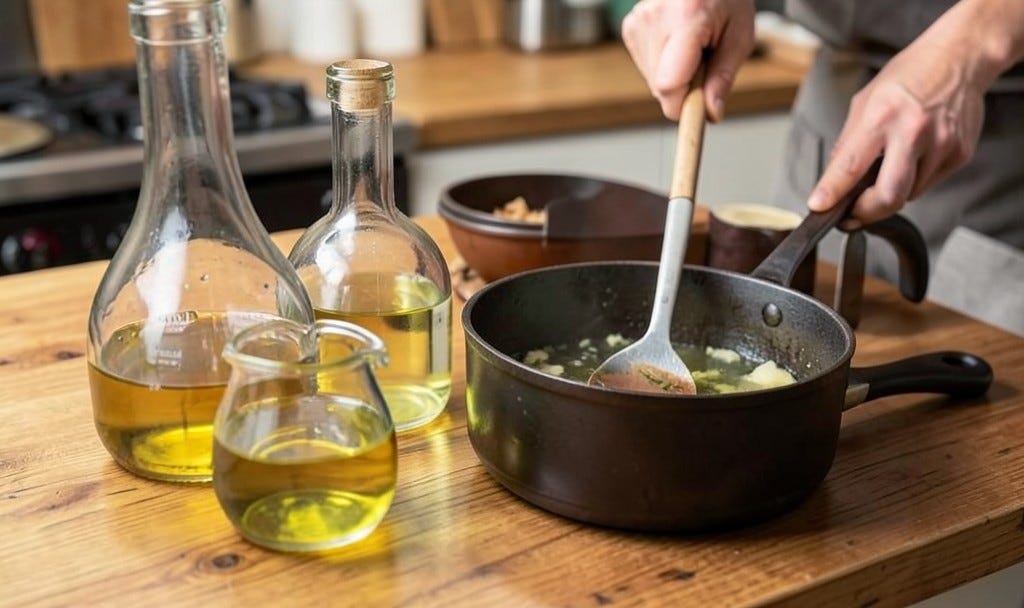
In a tiny house, camper van, or minimalist kitchen, every item needs to justify the space it takes up.
Cooking oil is no exception. You do not need six half-used bottles collecting dust in a cupboard. You need a few dependable, versatile, healthy cooking oils that match the meals you actually cook, your budget, and your long-term health.
The most important principle is not finding a magical oil. It is choosing fats that improve your overall dietary pattern. Research consistently finds that replacing saturated fats, such as butter, lard, and fatty meat, with unsaturated fats from plant oils can lower LDL cholesterol and reduce cardiovascular risk. LDL cholesterol matters because higher levels contribute causally to atherosclerosis, i.e. the buildup of fatty plaque in arteries that raises the risk of heart attack and stroke.
What’s the problem with LDL?
LDL cholesterol stands for Low-Density Lipoprotein. It is often called “bad” cholesterol because it can build up inside your blood vessels.
If you have too much LDL, it collects inside the walls of your arteries. This buildup forms a hard substance called plaque.
Plaque narrows your arteries and limits blood flow. It hardens the blood vessels over time (atherosclerosis). If a piece of plaque breaks open, it can cause a blood clot. This clogging increases your risk for heart attacks and strokes.
For most people, the simplest shelf is also the strongest: extra-virgin olive oil for flavour and cold use, plus rapeseed oil for neutral everyday cooking. Everything else is optional.
What makes a cooking oil healthy?
Oil is fat, and fat is energy-dense: regardless of the bottle, it is easy to consume a lot without noticing. The health difference lies mainly in the balance of fatty acids.
Monounsaturated fats, common in olive and avocado oil, are generally a heart-healthier replacement for saturated fats.
Polyunsaturated fats, found in rapeseed, sunflower, soybean, walnut, flaxseed, and similar oils, can also lower LDL when they replace saturated fats.
Saturated fats, abundant in butter, coconut oil, palm oil, and animal fats, tend to raise LDL cholesterol when consumed in excess.
The crucial word is replace. Swapping butter for olive oil on vegetables, or using rapeseed oil instead of animal fat for roasting, can be beneficial. Simply adding extra oil to an already calorie-heavy diet is not automatically healthy.
Extra-virgin olive oil: the best all-round choice
Extra-virgin olive oil is the most useful foundation oil for many households. It is rich in monounsaturated fat, especially oleic acid, and unlike refined olive oil retains flavour compounds and polyphenols from the olive.
Its best evidence comes from the wider Mediterranean dietary pattern. In the PREDIMED trial of 7,447 Spanish adults at elevated cardiovascular risk, a Mediterranean diet supplemented with extra-virgin olive oil reduced major cardiovascular events compared with a lower-fat control diet. Higher olive-oil intake has also been associated with lower cardiovascular disease and mortality risk in high-risk participants.
Benefits and risks
Olive oil can help improve heart-health markers when it replaces butter or other saturated fats. A systematic review of randomized trials found that olive-oil consumption was associated with reductions in total cholesterol, LDL cholesterol, and triglycerides (the most common type of fat found in your blood), although other plant oils sometimes lowered LDL more strongly.
Its main downside is not its fat profile but its cost and calorie density. Good extra-virgin olive oil is not cheap, and “more” is not necessarily better. It also has a pronounced flavour, which may not suit every meal.
Best uses: salads, dressings, cooked vegetables, eggs, soups, dips, roasted food, moderate-heat pan cooking, and finishing meals.
Minimalist verdict: Keep it. This is your main flavour oil and your best choice for meals where you will taste the oil.

Rapeseed oil: Europe’s quiet health champion
Rapeseed oil (called canola oil in North America) is one of the most practical best cooking oils for European kitchens. It is mild, affordable, widely available, and versatile enough for sautéing, roasting, baking, pancakes, and homemade mayonnaise.
It contains relatively little saturated fat and is rich in unsaturated fats, including monounsaturated fat and some alpha-linolenic acid, a plant-based omega-3 fatty acid. Research is particularly encouraging on LDL cholesterol: a 2023 meta-analysis in people with overweight or obesity found rapeseed oil reduced LDL cholesterol by an average of 0.14 mmol/L compared with other edible oils, while also reducing ApoB, a marker connected to atherogenic particles. A broader evidence review likewise found high-quality evidence that rapeseed oil can produce moderate LDL reductions when it replaces foods rich in saturated fat.
Benefits and risks
Rapeseed oil is a highly useful replacement for butter, lard, and tropical oils. Its neutral flavour and broad cooking range make that replacement easy in real life. The risk is mostly about storage and quality: oils rich in polyunsaturated fat are more vulnerable to degradation from prolonged heat, oxygen, and light. Buy a size you will use, keep it sealed, and store it in a dark, cool cupboard.
Best uses: everyday frying, sautéing, roasting, baking, pancakes, savoury dishes, and neutral dressings.
Minimalist verdict: Keep it. Alongside olive oil, rapeseed oil covers almost every ordinary cooking job.
Avocado oil: excellent, but not essential
Avocado oil is rich in monounsaturated fat and monounsaturated oleic acid, much like olive oil, and tends to have a milder flavour. It is popular for cooking at higher temperatures and for people who want a more neutral-tasting alternative to olive oil.
Benefits and risks
Its fat profile is favourable, and research suggests possible cardiovascular and metabolic benefits. However, the evidence base for avocado oil is smaller and less mature than the evidence for olive oil and rapeseed oil. Recent reviews still call for better standardized human trials. There is no strong reason to believe it is dramatically superior to olive or rapeseed oil.
The main disadvantages are price and the potential for poor-quality or adulterated products in a premium market. If your budget and storage are limited, avocado oil is a luxury option rather than a necessity.
Best uses: higher-heat cooking, roasting, grilling, and dishes where you want a mild flavour.
Minimalist verdict: Nice to have, but optional.

Coconut oil: useful for recipes, not daily health
Coconut oil is stable and has a distinctive flavour that works well in curries, some baking, and tropical dishes. It is also solid in cooler temperatures, which can make it convenient for travel.
But coconut oil is high in saturated fat. This does not make it toxic, but it does make it a poor default compared with olive or rapeseed oil. In a randomized trial, coconut oil produced higher LDL cholesterol than olive oil, while butter raised LDL even more than both oils.
Benefits and risks
Coconut oil can be enjoyable, heat-tolerant, and useful in a narrow set of recipes. The problem comes when it is marketed as a heart-health superfood. It is not. If you have high LDL cholesterol, cardiovascular disease, diabetes, or a strong family history of early heart disease, it is especially sensible to keep coconut oil occasional and prioritize unsaturated oils instead.
Best uses: occasional curries, baking, desserts, or recipe-specific flavour.
Minimalist verdict: Optional. Use it when its flavour adds something specific, not as your everyday frying oil. I use them for my protein pancakes purely for taste.

Palm oil: practical, but rarely the best choice
Palm oil is common in processed foods because it is relatively inexpensive, stable, and semi-solid at room temperature. It is also used in various traditional cuisines. But it contains a high proportion of saturated fat (up to 50%), making it rather unhealthy as a routine cooking oil.
The science is mixed on disease outcomes. One review found no clear association between palm-oil consumption and cardiovascular disease events, while other evidence suggests palm oil may raise LDL cholesterol relative to vegetable oils lower in saturated fat. In practical terms, there is little nutritional reason to choose palm oil over olive or rapeseed oil for everyday use.
There is also an ecological consideration. Palm oil production is often linked with deforestation and biodiversity loss. For a lifestyle built around nature and conscious consumption, this is worth taking seriously.
Best uses: occasional traditional cooking when you have a reason to use it and can source it responsibly.
Minimalist verdict: Usually skip it as a home-kitchen staple.
Nut and seed oils: flavourful but fragile
Walnut, hazelnut, pumpkin-seed, sesame, flaxseed, sunflower, and peanut oils each bring something different. In general, they are sources of mostly unsaturated fat, which can support healthier LDL levels when they replace saturated fats. For example, replacing saturated fats with unsaturated fats from walnuts or vegetable oils has improved LDL cholesterol, non-HDL cholesterol, and total cholesterol in controlled research.
But these oils differ significantly in heat tolerance and flavour. Walnut and flaxseed oils are best used cold because their more delicate polyunsaturated fats can degrade with heat. Toasted sesame oil is better as a finishing oil than a frying oil. Peanut oil is more heat-tolerant and works well for stir-fries. Sunflower oil is neutral and commonly used, though high-oleic versions tend to be more suitable for higher-heat cooking.
The best nut oil for high-heat cooking is from the macadamia nut. If you need an oil for frying, roasting, or searing, macadamia nut oil is arguably the healthiest option in the entire oil aisle. It consists of up to 80% oleic acid, the highly beneficial monounsaturated fat that lowers blood pressure and protects your heart. It contains even more monounsaturated fat than extra virgin olive oil.
Benefits and risks
Nut and seed oils add variety, flavour, and unsaturated fats. Their main risks are rancidity, high cost, and overbuying. A large bottle of walnut oil that sits for a year in a warm van cupboard is neither healthy nor minimalist.
Best uses: cold dressings, finishing soups and vegetables, dips, sauces, and occasional cuisine-specific meals.
Minimalist verdict: Choose one small bottle you genuinely love, refrigerate delicate oils after opening where practical, and use it steadily.
A safe DIY addition
A simple DIY herb oil can make basic food more enjoyable without buying several sauces. Add fully dried rosemary, thyme, chilli, or citrus peel to extra-virgin olive oil. Leave it in a cool, dark place for several days, then strain it if you prefer. Use it on potatoes, beans, grilled vegetables, bread, or salads.
Avoid storing fresh garlic or fresh herbs submerged in oil at room temperature. Their moisture can create a food-safety risk. Dried ingredients are the safer option.
Your simple oil shelf
In the table below, I summarize the main aspects of the various oils for cooking that I looked at.
The Rich Minimalist takeaway
The healthiest oil is not the most expensive bottle or the newest wellness trend. It is the one that helps you cook real food consistently while replacing saturated fats and ultra-processed food with better sources of unsaturated fat.
For most people, that means keeping extra-virgin olive oil and rapeseed oil at home. Olive oil provides flavour and a strong Mediterranean-style evidence base. Rapeseed oil provides affordability, versatility, and particularly credible LDL-lowering potential when used in place of saturated fats.
Own fewer oils. Store them well. Use them deliberately. Let your diet be built around whole foods, movement, time outdoors, and simple meals that make you feel good, rather than around an endless hunt for the perfect ingredient.
If this kind of practical approach to tiny house living, minimalism, and self-sufficiency resonates with you, consider subscribing to The Rich Minimalist. It’s free.
Or just leave a comment or a ❤️