

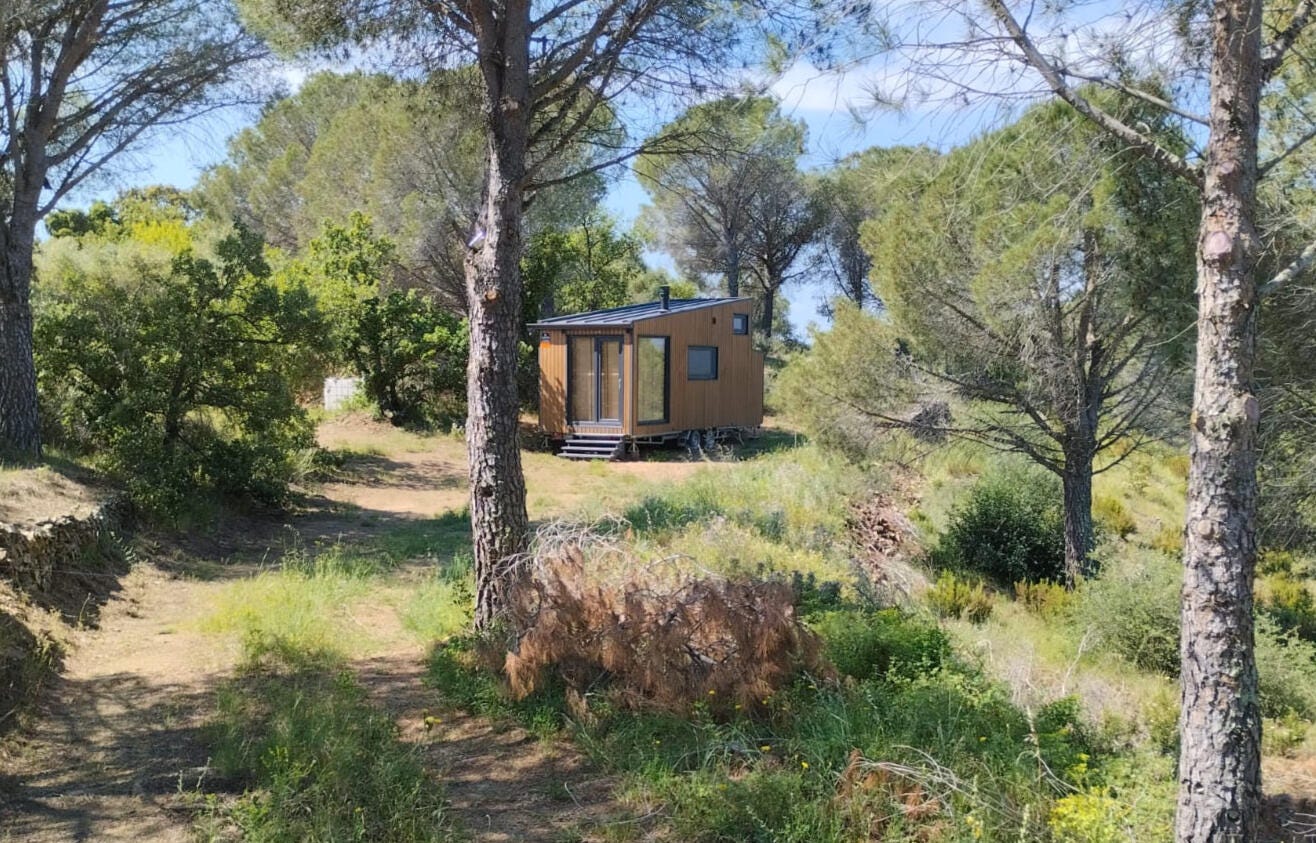
When most people picture a home office, they imagine a dedicated room, a massive desk, an ergonomic chair that costs as much as a small car, and a bookshelf that looks like it belongs in an Ivy League library.
But often it is still “only” part of a flat in a city. In the middle of the crazy rat race. I’ve learned something important over the last year living in my Berkana Othala tiny house:
True creative focus isn’t about square footage.
It’s about cognitive hygiene.
In fact, the constraints of a tiny house are the best thing that ever happened to my deep work. When you don’t have the space to sprawl, you are forced to be incredibly intentional about how you set up your environment. You aren’t building an “office”; you are building a “Deep Work Cell.”
Here is how I turned my tiny space into a creative sanctuary, and how you can do the same, even if you’re living in a van, a tiny house, or just a small studio.
1. The Power of “Context-Dependent” Focus
In a normal house, the office is where you work, but also where you pay bills, scroll social media, and watch Netflix. The environment is “polluted” with too many contexts. In a tiny house, you don’t have the luxury of separate rooms, so you have to use ritual to create boundaries.
My work cell is where I work on my projects, produce content, manage my apps, work and write. It is a “work-only” zone. When I sit at my desk, I don’t look at my bed. I don’t look at the fridge. I look at my screen, my notes, and the window that gives me a view of nature—pure nature. I see the forest, hills, snow covered Pyrenees in the distance.
The rule is simple:
If I’m in that seat, I’m working. If I’m not working, I’m not in that seat. By training my brain to associate that specific corner with deep focus, I can drop into a flow state in minutes rather than hours. You don’t need a door to separate work from life. You need a behavioral switch.
On the flip side, sometimes I don’t manage to get into high productivity mode. In that case, I also try not to force it. Well, sometimes I must (deadline…). But when not, then I try to distract my body and brain by doing something else. Usually a short walk outside or ten pullups, twenty pushups, and thirty squats outside get me back on track.
2. Eliminate Visual Noise (The Minimalist Advantage)
One of the biggest enemies of creativity is “visual debt.” It’s the pile of papers you don’t need, the stack of books you haven’t opened, the gadgets on your desk that you might use one day. In a large home, you can hide this stuff. In a tiny house, it’s staring you in the face.
I treat my desk (which is my table, my only table) like a sterile operating theater. Everything I need for the current task is out. Everything else is not on the table. The task could be writing an article, nerding on an app, cooking, eating, or woodwork. Whatever it is, only the stuff I need for that task is on the table.
If I’m laptop work, all I have is my laptop and maybe pen and paper for quick notes. That’s it. No stack of reference books. No second monitor taking up space. No tangled mess of cables. Because I have so little space, I’ve had to digitize almost everything I own. My “reference library” lives in the cloud, and my “stationary” lives in one small drawer. This isn’t just about space-saving. It’s about reducing the cognitive load on my brain.
When you have less to look at, you have more mental capacity to think.

3. Optimizing for “The View” (Nature as a Partner)
People spend thousands on office decor and buy huge posters showing inspirational photos of nature. I’ve found that the best backdrop for creative work is the one you can’t buy: actual views into actual nature.
In my tiny house, my desk is oriented toward the window. Most people are skeptical of a window in front of a desk because it’s a “distraction.” I think that’s dead wrong. When you are doing deep work, you need a way to rest your eyes and reset your mind. A screen is taxing. A view of the Pyrenees, the wind moving through the trees, or a bird landing on a branch is restorative.
I use the view as my “refresh” button. When I’m stuck on a piece of code or struggling to finish a newsletter draft, I don’t check my phone. Well, sometimes yes, I am not holy. But mostly I just look out the window. I watch the landscape. It takes thirty seconds, and I’m back in. It’s an analog reset that keeps me from spiraling into the digital rabbit hole of useless unproductivity.
4. Hardware Minimalism
If you’re working from a tiny space, your tech needs to be as mobile and efficient as your house. I’ve moved away from the “desk setup” mentality. I don’t have a giant printer, a desktop tower, large (second) screen, or a complicated speaker system. Generally, I own less and focus on owning more time than stuff, which is another topic.
I use:
A kinda powerful, lightweight laptop.
Noise-canceling headphones. Even in the mountains, there’s wind, rain, or Anthony’s chickens. Headphones are my “portable walls.”
A bluetooth mouse. It sounds silly and most people just use the trackpad on their laptop. But I think this is incredibly slow and drives me crazy.
When you simplify your hardware, you lower the barrier to starting. I can be “at work” in ten seconds. If I’m traveling, my office packs into a single, small bag. That mobility is a form of freedom that makes the work feel less burdensome.
5. Protecting the “Deep Work” Window
In a tiny house, it is very easy for small interruptions to become big problems, which I guess is true for any house and type of living anyway.
This is why I protect my mornings. I don’t check email until the “Deep Work” window is closed. I don’t look at any support requests or community feeds. I focus on the hardest task first: the writing, the coding, the big-picture thinking—the BHAG.
By the time the house needs maintenance or the world demands my attention, the most important work of the day is already done. It’s a huge relief. I’m not carrying the weight of an unfinished project all day long. I’m finished, satisfied, and free to deal with the realities of off-grid life without feeling like my work is suffering.
But obviously, I am not sticking to this routine every day. Sometimes it’s unavoidable to do it later, split the deep work window in half, or don’t do it at all. I want to progress, but I also want to enjoy.
Designing Your Own Cell
You don’t need a tiny house to build a Deep Work Cell. You just need a “tiny attitude”.
Dedicate a “Zone”: Even if it’s just one end of a kitchen table, make it “The Cell.” When you’re there, you’re there.
Clear the Decks: Spend five minutes clearing every single item that isn’t essential to the current task.
Control the Noise: Use high-quality headphones to create an audio bubble.
Anchor to Nature: If possible, face a window. If not, put a plant or a piece of nature-inspired art in your line of sight.
Protect Your Start: Don’t let the world into your head until you’ve put your own work out into the world.
Working from a tiny space taught me that I don’t need a sprawling office to be a professional. I just need focus, simplicity, a small place where I can show up and do the work, and less distraction or “productive” distraction, which is looking at nature and its movements.
I’ve produced more in the last six months inside this wooden box than I did in years of working in a corporate cubicle or a “proper” office. It turns out, when you get rid of the extra space and the extra stuff, all you’re left with is the work on your projects. And that’s exactly where the magic happens.
If you’re interested in how to structure your work, money, and life to create more room for these kinds of passion projects, consider subscribing to The Rich Minimalist. I’ll keep sharing the practical, down-to-earth lessons I’m learning from life in the wilderness.
Or just leave a comment or a ❤️